80064 is a British Railways Standard Class 4MT 2-6-4 tank engine: a modern, powerful design of the 1950s, built to haul passenger trains on suburban and branch lines. She is one of fifteen of her class to survive.
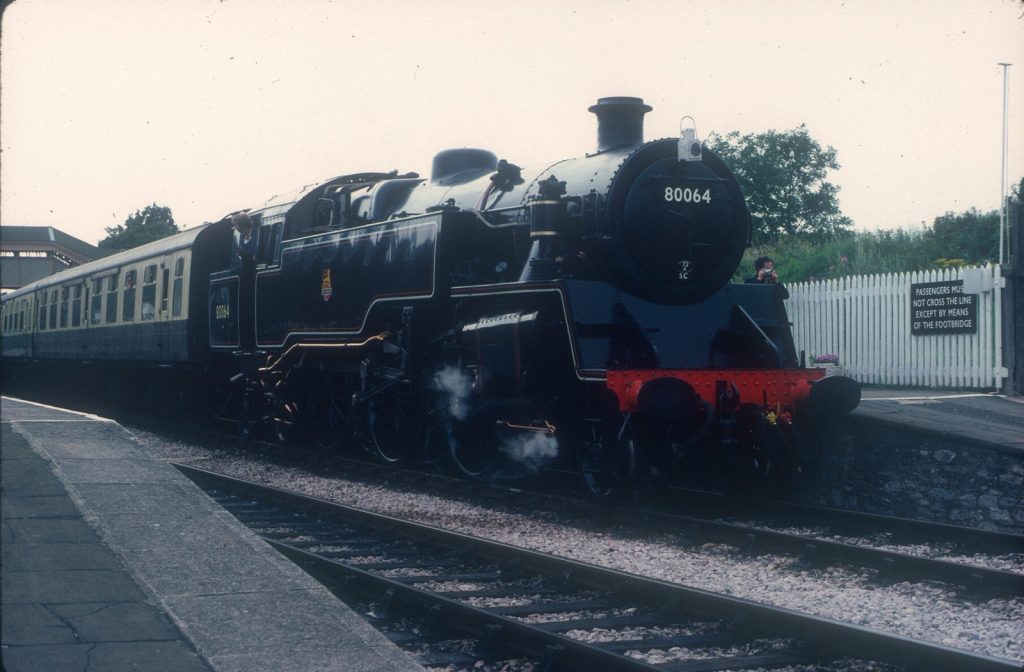
The Standard Class 4 tanks
After nationalisation in 1948, British Railways drew up a family of twelve ‘Standard’ steam designs to replace the many older types it had inherited from the private companies. Parts were shared between classes wherever possible, making the engines cheaper to build and easier to maintain.
The Class 4 tank was drawn up at Brighton and based closely on the successful LMS Fairburn 2-6-4 tanks. 155 were built between 1951 and 1956, most at Brighton Works and the rest at Derby and Doncaster. They worked passenger trains across much of the country, from the London suburbs to Scotland.
As a tank engine, 80064 carries her own coal and water in a bunker and side tanks rather than pulling a separate tender. That lets her run equally well in either direction, which made the class ideal for busy routes with no time to turn engines round.
| Feature | Class 4 tank |
|---|---|
| Wheel arrangement | 2-6-4T (two leading wheels, six driving wheels, four trailing wheels) |
| Power classification | 4MT (mixed traffic) |
| Built | 1951–1956 at Brighton, Derby and Doncaster |
| Number built | 155 |
| Number preserved | 15 |
| Driving wheels | 5 ft 8 in diameter |
| Boiler pressure | 225 lb per square inch |
| Tractive effort | About 25,100 lb |
| Weight in working order | About 86 tons |
Check the class figures in this table against WSRA’s records.
80064’s story
Building and early years
80064 was built at Brighton Works and entered service in June 1953. She was first allocated to the London Midland Region, then moved to the Southern Region in December 1959.
When the Kent Coast lines were electrified, 80064 was sent west to Exmouth Junction in Devon. In September 1963 the lines around Exeter passed to the Western Region, and she became a Western Region engine.
Withdrawal
80064 was withdrawn in September 1965, after only twelve years in service, and sold for scrap to Woodham Brothers at Barry in South Wales. She arrived there in October 1965 and stood in the scrapyard for more than seven years.
Rescue and preservation
In February 1973 she was bought by the 80064 Locomotive Fund and moved to Buckfastleigh on the Dart Valley Railway, now the South Devon Railway, where the long work of restoring her began. She steamed again in 1981.
In 1984 her owners moved her to the Bluebell Railway in Sussex, where she worked for several years until her boiler certificate expired around 1989. Many of the photographs in our gallery date from these years in Devon and Sussex.
Coming to the WSRA
Towards the end of 2023 the 80064 Locomotive Fund donated the engine to the West Somerset Railway Association, and she moved to the West Somerset Railway.
Engines of this type have worked on the West Somerset Railway before and are well suited to its steep gradients and heavy trains. Once restored, 80064 will help keep steam running on the WSR as other locomotives come out of service for their own overhauls. You can follow every step on the restoration page.
Can I see 80064?
Not at the moment. The engine is under restoration and is not on public display. When there is a chance to see her, we will announce it on the news page and the WSRA Facebook page.
Help return 80064 to steam
The restoration is funded entirely by donations. If you are a UK taxpayer, Gift Aid adds 25p to every £1 you give, at no cost to you.